
Introduction to DeepSeek AI
The Emergence of DeepSeek AI
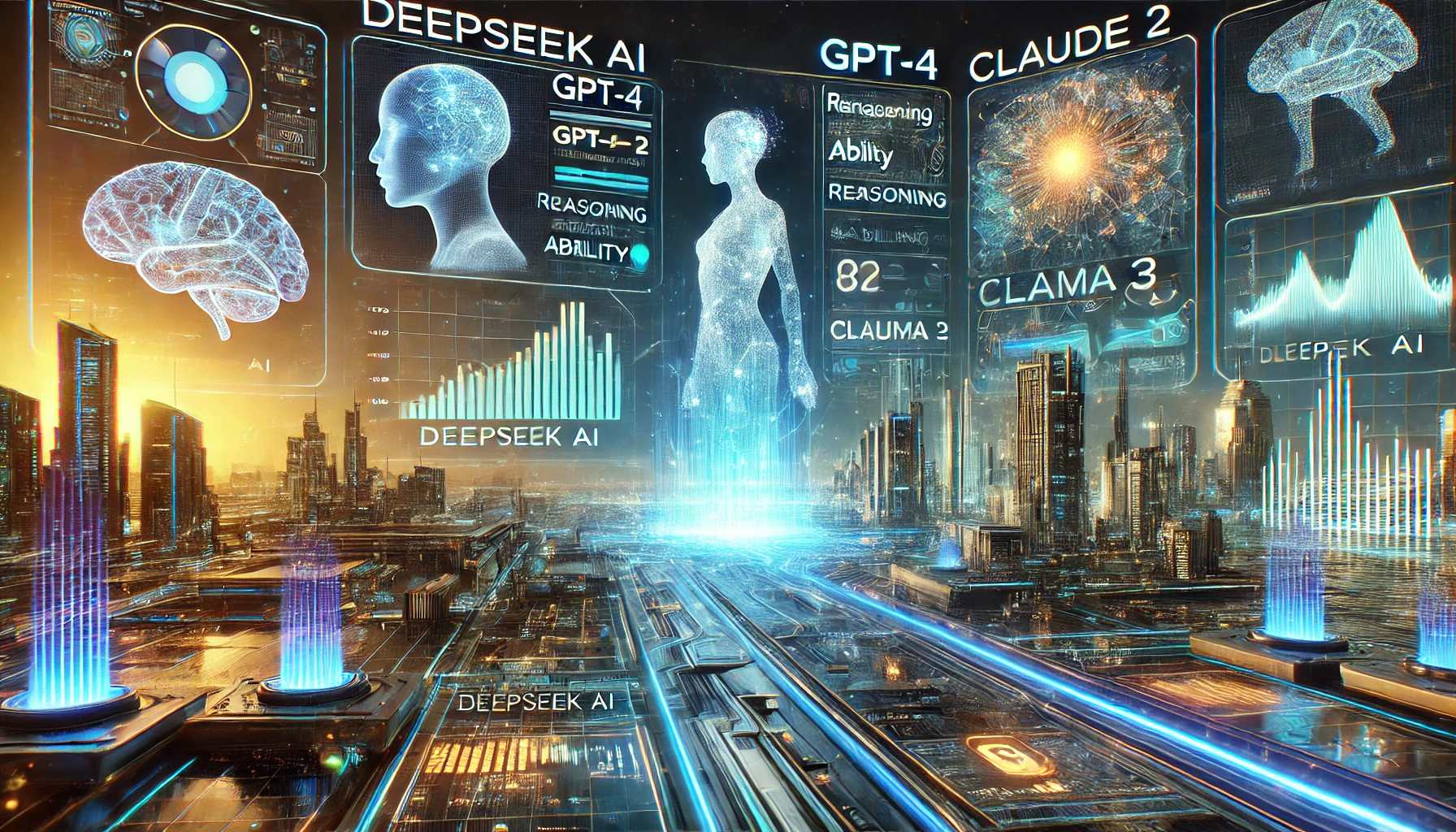
Artificial intelligence (AI) is evolving at an unprecedented pace, with new players entering the field to challenge industry giants. One of the latest and most promising AI developments comes from DeepSeek AI, a Chinese AI company that has positioned itself as a competitor to OpenAI’s GPT-4, Anthropic’s Claude, and Google’s Gemini. DeepSeek AI, operating under High-Flyer, a quantitative hedge fund based in Hangzhou, China, has focused on developing open-source AI models with impressive capabilities at a significantly lower cost than its Western counterparts.
Cost-Efficiency and Competitive Edge
One of the standout features of DeepSeek AI is its cost efficiency. While OpenAI’s GPT-4 reportedly cost around $100 million to train, DeepSeek-R1 was developed for less than $6 million. This drastic reduction in computational resource expenditure demonstrates a shift in AI development strategies, proving that high-performance AI models can be developed with more economical approaches.
Key Features of DeepSeek AI Models
Open-Source Nature
DeepSeek AI has committed to making its models open-source, allowing the AI community to access, modify, and refine its algorithms. This transparency fosters greater innovation and customization options for researchers and developers worldwide.
Low-Cost Development
Unlike its competitors, which require substantial infrastructure investments, DeepSeek AI’s training and fine-tuning processes are designed to be more resource-efficient, making it accessible to a broader audience.
Advanced Reasoning Capabilities
DeepSeek-R1 excels in complex problem solving, including logical reasoning, technical specifications analysis, and mathematical reasoning. This makes it a valuable tool for industries that require deep understanding and high-level decision-making.
Multilingual Processing
DeepSeek models support multiple languages, enhancing their natural language processing (NLP) capabilities. This makes them ideal for businesses looking to implement AI solutions across diverse linguistic markets.
Highly Scalable
With applications ranging from content creation to real-world applications in data science, machine learning, and AI research, DeepSeek’s AI capabilities are designed to be highly scalable and adaptable.
DeepSeek Models and Release History
Development and Evolution
DeepSeek AI has been consistently refining its models to compete with some of the most advanced AI models available. Below is an overview of its key releases:
|
Model Name |
Key Features |
Release Date |
|---|---|---|
|
DeepSeek-R1 |
Advanced NLP, complex reasoning, superior AI capabilities |
2024 |
|
DeepSeek-Coder |
Optimized for coding tasks and software development |
2023 |
|
DeepSeek-Chat |
Focused on human preference alignment for AI interactions |
2022 |
Each iteration has improved performance, demonstrating DeepSeek’s ability to stay ahead in the AI race.
Head-to-Head Comparison: DeepSeek vs. Other AI Models
|
Feature |
DeepSeek-R1 |
GPT-4 |
Claude 2 |
LLaMA 3 |
|---|---|---|---|---|
|
Training Cost |
<$6 million |
~$100 million |
~$70 million |
~$10 million |
|
Open-Source |
✅ Yes |
❌ No |
❌ No |
✅ Yes |
|
Complex Reasoning |
✅ Strong |
✅ Strong |
✅ Strong |
✅ Moderate |
|
Mathematical Reasoning |
✅ Competitive |
✅ Best |
✅ High |
✅ Moderate |
|
Coding Tasks |
✅ Optimized |
✅ Strong |
❌ Limited |
✅ Moderate |
|
Multilingual Support |
✅ Yes |
✅ Yes |
✅ Yes |
✅ Limited |
DeepSeek-R1 holds a slight edge in areas like cost-efficiency, open-source accessibility, and specialization in niche tasks like coding and mathematical problem-solving.
Performance Comparison: Strengths and Weaknesses
Strengths
-
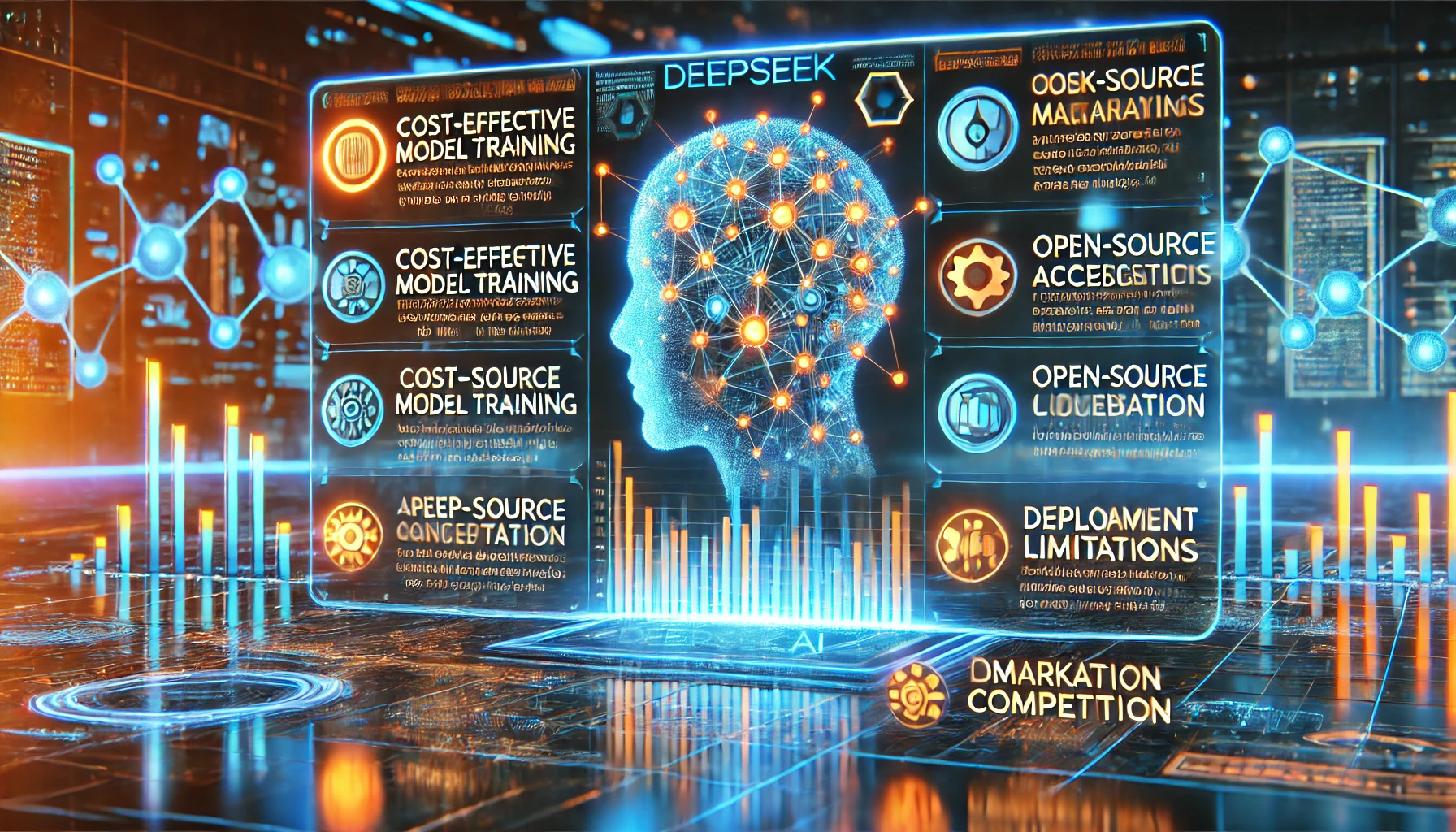
Cost-Effective Model Training – Uses fewer computational resources to achieve comparable results.
-
Open-Source Accessibility – Encourages AI development and further research.
-
Customization Options – Can be tailored for industry-specific applications.
-
Advanced Coding Capabilities – Excels in solving programming problems and generating high-quality code.
-
Competitive NLP Skills – Shows strong performance in text understanding, reasoning ability, and creative writing.
Challenges and Limitations
-
Not Yet a Market Leader – Competing against well-established AI models like GPT-4.
-
Slightly Lower Fluency – Some evaluations suggest GPT-4 still leads in nuanced conversation handling.
-
Limited Large-Scale Deployment – Not as widely integrated into enterprise systems as OpenAI’s solutions.
Future Developments and Updates
DeepSeek AI continues to push the boundaries of AI development by investing in reinforcement learning, human-AI interaction, and AI-driven solutions for various industries. Upcoming advancements include:
-
Enhancing Human-AI Interaction – Improving human preference alignment.
-
Expanding Customization Features – Allowing deep integration into business processes.
-
Advancements in Reinforcement Learning – Improving AI’s ability to learn from real-world data.
-
Scaling AI for Broader Industry Use – AI-driven solutions for finance, healthcare, and tech industries.
Conclusion: Choosing the Right AI Model

DeepSeek AI is disrupting the AI landscape with its cost-efficient, open-source models that rival industry leaders like GPT-4 and Claude 2. By offering superior performance in reasoning, multilingual tasks, and customization, DeepSeek AI presents an attractive alternative for businesses, researchers, and developers.
For those looking to leverage AI for problem-solving, content creation, data science, or technical applications, DeepSeek AI’s models provide an affordable and powerful solution.
Further Reading and External Links
-
DeepSeek AI Official Website
-
Google Gemini AI
DeepSeek AI’s emergence signals a new era in artificial intelligence, demonstrating that open-source, cost-effective solutions can compete with the best AI models available today.
Can you be more specific about the content of your article? After reading it, I still have some doubts. Hope you can help me.