
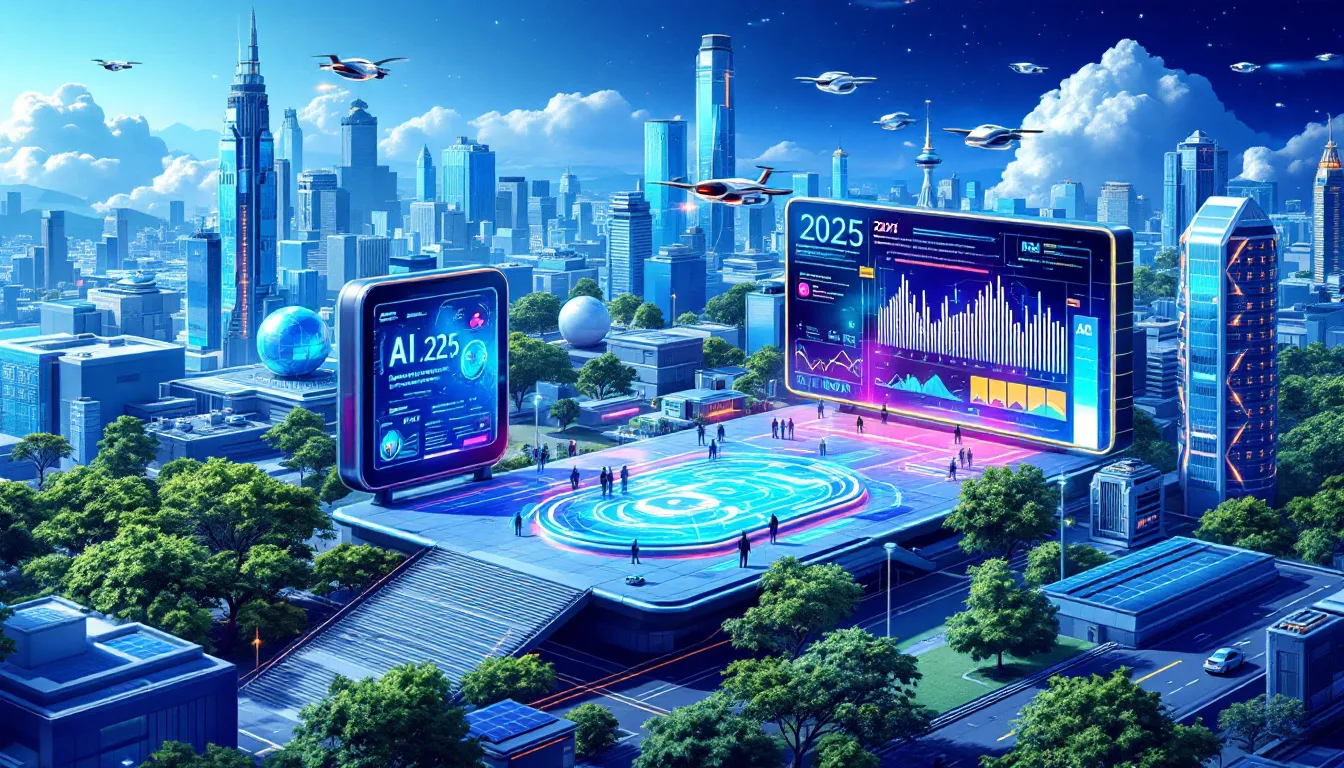
Technology has always shaped the way we live, work, and connect. In 2025, we are standing at the edge of a new era, where emerging technologies like AI models, quantum computing, digital agents, foundation models, and autonomous systems are expected to change everything. Business leaders are not just observing these shifts—they are investing billions to ensure their organizations stay ahead of the curve.
In this blog, we’ll dive deep into the next frontier of technology trends, exploring AI-powered innovation, responsible AI, data security, generative AI, and ecosystem readiness. Let’s see what’s on the horizon for the next decade and how companies can prepare for this new wave of innovation.
Artificial Intelligence and Machine Intelligence: The Core of Innovation
Artificial Intelligence (AI) is no longer just a buzzword—it’s a core driver of progress. From automating specialized tasks to solving complex problems at scale, AI is enabling capabilities we could only dream of a decade ago.
-
Agentic AI and semi-autonomous systems are beginning to execute multistep workflows without constant human oversight.
-
Industries like healthcare, finance, and logistics are embracing machine intelligence for greater accuracy, efficiency, and cost savings.
-
Business leaders are deploying AI models not just for automation but also for strategic decision-making and predictive analysis.
Fact: According to McKinsey’s 2025 report, AI adoption has the potential to increase global GDP by $13 trillion by 2030 (source).
Digital Agents and Automation: The Rise of AI-Powered Workflows
Digital agents are at the forefront of automation in 2025. These AI-powered assistants are capable of managing large-scale workflows, customer interactions, and operational tasks.
-
Efficiency gains: Companies are reporting up to 40% cost savings when leveraging digital agents.
-
Customer experience: AI chatbots, powered by gen AI, can handle complex queries with human-like responses.
-
Workforce readiness: The rise of automation emphasizes the need for new skills training so humans can work alongside AI tools instead of being replaced.
Case Study: IBM Watson Orchestrate helps enterprises execute multistep workflows—from scheduling meetings to preparing reports—showcasing how AI-powered agents reduce repetitive tasks (source).
Foundation Models: Building the Future of Intelligent Systems
At the core of this new era are foundation models—large AI models trained on vast datasets that can be adapted for multiple tasks.
-
These models underpin gen AI applications in text, code, design, and even robotics.
-
Business leaders are using foundation models to create custom AI solutions across industries.
-
As these systems grow, data security and trust become even more critical.
Example: OpenAI’s GPT family and Google’s Gemini are foundation models that power multimodal AI applications. Their adaptability makes them the cornerstone of next-decade AI systems.
Generative AI and Creative Applications
Generative AI (gen AI) is one of the most transformative emerging technologies in 2025.
-
In media and entertainment, gen AI is being used to create music, films, and advertisements.
-
In business, gen AI helps design products, generate marketing campaigns, and simulate financial outcomes.
-
It’s not just about automation—it’s about human-AI collaboration.
Quote: As Sam Altman (CEO of OpenAI) stated, “Generative AI will not replace human creativity—it will amplify it.”
Fact: By 2026, 60% of businesses are expected to integrate generative AI into their daily workflows (source).
Digital Trust and Data Security
With the rise of AI-powered systems, digital trust has become a non-negotiable priority.
-
Cybersecurity threats are increasing in scale and complexity.
-
Companies are investing in AI-driven security tools that detect anomalies in real time.
-
Regulations like the EU AI Act are pushing industries toward responsible AI development.
Key Focus Areas:
-
Building trust frameworks for data sharing.
-
Protecting sensitive information against cyberattacks.
-
Ensuring responsible AI applications through transparency and accountability.
Read more about AI regulations and digital trust here.
Innovation and New Technologies: Quantum Computing & Augmented Reality

The next frontier is not just about AI—it’s about new technologies reshaping industries:
-
Quantum Computing: With the ability to solve problems millions of times faster than classical computers, quantum tech is expected to revolutionize drug discovery, logistics, and climate modeling.
-
Augmented Reality (AR): AR is bridging digital and physical worlds, transforming education, healthcare training, and remote work collaboration.
Chart: Expected Market Growth (2025–2030)
|
Technology |
Estimated Market Value 2030 |
CAGR (2025–2030) |
|---|---|---|
|
Quantum Computing |
$90 Billion+ |
33% |
|
Augmented Reality (AR/VR) |
$450 Billion+ |
25% |
|
AI & Automation |
$1.5 Trillion+ |
37% |
(Source: PwC Future Tech Report 2025)
Future Outlook and Implications
The future of emerging technologies in 2025 will bring massive opportunities—but also unique challenges.
-
Infrastructure Readiness: Companies must invest in computing power, data centers, and energy efficiency.
-
Ecosystem Readiness: Governments, industries, and academia must collaborate for responsible AI growth.
-
Long-Term Vision: Leaders must adopt a sustainable approach to innovation, focusing not just on profit but also on societal value.
Global Cooperation: The next decade will require cross-border collaboration to address AI governance, security, and ethical deployment.
Final Words

The next frontier of emerging technologies in 2025 promises to change everything—from how we work, learn, and create to how we build trust, solve problems, and innovate. Artificial intelligence, generative AI, quantum computing, digital agents, and foundation models are leading us into a new era of intelligent systems.
The challenge is clear: responsible AI, robust data security, new skills training, and ecosystem readiness will determine whether this technological revolution benefits everyone.
If you want to explore more on AI, blockchain, and sustainable tech, check out our detailed blogs at NextGenTech Info and GoGreenInsights.
FAQs
1. What are the top emerging technologies in 2025? AI models, generative AI, quantum computing, augmented reality, and digital agents.
2. How will business leaders benefit from these technologies? They will gain efficiency, cost savings, and the ability to execute multistep workflows with greater autonomy.
3. Why is responsible AI important? Because without transparency and trust, AI adoption could face resistance and lead to security breaches.
4. What skills will be in demand in the next decade? AI engineering, cybersecurity, data science, quantum computing, and ecosystem readiness.
5. What’s the long-term vision for AI and emerging tech? To create innovative solutions that balance profit, progress, and planetary well-being.
