
In this blog post, we’ll explore human AI collaboration in creative fields — music — focusing on how human creativity, AI algorithms, and collaborative workflows are reshaping the creative process. We’ll dive deep into how AI tools are being used in music composition, production, and performance, discuss ethical considerations, and present case studies, data, and design insights. Throughout, key concepts like human creativity, AI systems, creative blocks, generative AI models, emotional depth, and ethical guidelines will be emphasized.
Introduction to Music Creation in the Age of AI
Music has always been a deeply human artform—rooted in emotion, storytelling, intuition, and cultural context. At its core lies human artistic expression, the spark that transforms sound into meaning. Yet, as artificial intelligence (AI) has matured, the creative landscape is evolving: AI now functions not just as a tool, but as a creative partner in music.
The phrase “human AI collaboration in creative fields music” captures this shift. Rather than AI replacing human creators, the synergy arises when human intuition and emotional depth join forces with AI’s computational power, pattern recognition, and generative capabilities.
In music creation today, AI-powered systems can propose melodies, chord progressions, rhythmic ideas, assist in arrangement and mixing, or even generate entire backing tracks. This introduces a new question: what is the evolving role of the human creator? Is the human simply an editor or curator, or does the human remain central to the emotional and conceptual cohesion of the piece?
In this blog, we examine:
-
The role of AI in music creation
-
The enduring importance of human creativity
-
Ways AI can enhance the creative process
-
Ethical, legal, and practical challenges and how we might address them
-
Case studies and emerging trends
-
Design principles for better human-AI collaboration in music
Let’s start by diving into how AI is entering the domain of music.
The Role of AI in Music Creation
AI as a Creative Partner
Rather than viewing AI as a replacement for human musicians, many see it as a creative partner. AI can provide fresh, unexpected musical ideas or variations that a human might not immediately conceive. In such collaborations:
-
AI offers stimuli (ideas, fragments, textures)
-
The human shapes, filters, modifies, and curates
-
The final piece emerges from a dialogue between human vision and AI suggestion
This collaboration leverages the complementary strengths: AI’s speed, scale, pattern-finding, and brute-force exploration; the human’s emotional judgment, intentionality, context, and sense of coherence.
Research at Carnegie Mellon suggests that combining AI with human designers and songwriters can produce outcomes superior to what either could do alone. AI helps break creative ruts, while humans apply “taste” and sense of message/feeling. (Human-Computer Interaction Institute)
What AI Can Do: Composition, Arrangement, Production
AI is being used across many stages of music creation:
|
Stage |
AI Capability |
Benefit / Use Case |
|---|---|---|
|
Composition & Melodic Generation |
Propose melodies, chord progressions, motifs |
Idea seeding, generating multiple variations |
|
Arrangement & Orchestration |
Suggest instrumentation, voicings, textures |
Translating skeleton ideas into full arrangements |
|
Production & Mixing |
Auto-EQ, mastering, dynamic processing, separation of stems |
Speeding up technical tasks, enabling non-experts to get polished output |
|
Performance & Interaction |
Real-time accompaniment, improvisation, robotic musicians |
AI that “plays along” (e.g. percussion robots) |
|
Personalization & Style Transfer |
Adaptation to a user’s taste or genre |
Creating music that aligns with a given artist’s style or mood |
For example, AI tools can analyze large musical datasets and generate novel melodies, harmonies, or rhythms by learning statistical patterns and structures in music. (Edwards Creative Law)
In production, AI-powered tools are increasingly used to synthesize performance elements, perform editing, post-production tasks, and assist in mastering. (Information Week)
The global AI in music market is projected to grow rapidly (e.g. from hundreds of millions to potentially billions in value), underlining how AI tools are becoming more central to the music industry.
Ethical and Legal Considerations
When AI enters creative industries, ethical questions arise:
-
Copyright & Training Data Many generative models are trained on large corpora of copyrighted music. The degree to which this constitutes infringement or “fair use” is a matter of ongoing litigation. (Forbes) For instance, lawsuits have been filed against AI music services like Suno and Udio for using copyrighted recordings without license. (RIAA)
-
Authorship & Attribution If AI generates large swaths of music, who is the “author”? The user, the AI system, or the creators of the AI? Legal frameworks are still catching up.
-
Job Displacement & Industry Impact Some fear that AI may reduce demand for certain roles (ghost producers, arrangers, composers of background music). Yet, others argue AI will shift roles to more creative oversight, curation, and conceptual direction.
-
Transparency & Accountability Users (listeners, artists) should know when content is AI-generated or human-AI collaborated. Platforms are beginning to flag AI-generated content (for example, Deezer now tags albums that use AI content). (AP News) In the broader media space, concerns about “AI slop” (i.e. flood of low-quality AI-generated content) are also rising. (Financial Times)
-
Ethical Guidelines & Best Practices Many scholars advocate for human-centered AI, transparency, user consent, limitations on training data, and equitable licensing models.
Ethical reflection is essential if human creators are to retain dignity, ownership, and purpose in a changing creative landscape.
Human Creativity in Music: Why It Still Matters
AI can generate patterns and propose options, but human creativity, intuition, and emotional depth remain indispensable. Here’s why:
-
Emotional Resonance: Humans tap into lived experience, narrative, cultural memory, and emotional subtlety. Music that truly moves us often carries friction, imperfection, nuance—qualities AI may struggle to replicate.
-
Concept, Vision & Intention: Humans conceive concepts, stories, metaphors, and identity. AI lacks intrinsic goals or meaning; it requires human direction.
-
Critical Judgment & Curation: AI may propose many possibilities. The human’s role is to filter, refine, decide what fits the vision, what to discard.
-
Context & Adaptivity: Human creators understand their audience, social and cultural contexts, evolving trends, and can pivot when something “feels off.”
-
Creative Blocks & Divergence: When humans get stuck, AI can spark new angles; when AI suggestions stall, human ingenuity must take over.
A study published in ISMIR explored how musicians perceive and use AI in their process, identifying both excitement and friction. Some creators worry about losing agency or ending up a “curator of AI output.”
Likewise, the case study “Exploring the Collaborative Co-Creation Process with AI” (2025) documents how novice music teams used AI across ideation, collaging, integration, and release. It highlights how AI accelerates ideation but also compresses traditional preparation phases, pushing humans to spend time on selection, validation, and coherence. (arXiv)
In short, human ingenuity, emotional depth, and purposive direction remain central, even as AI becomes more capable.
Enhancing the Creative Process: How AI Supports Musicians

Here are concrete ways AI can enhance the creative workflow and help overcome creative blocks, democratize creation, and unlock new musical forms.
1. Idea Generation & Ideation Phase
-
Prompt-based generation: Input a text prompt (e.g. “melancholic piano in D minor, ambient texture”) and the AI generates multiple options.
-
Variation and exploration: Given a seed motif, AI can propose multiple variants (melodic flips, rhythm shifts).
-
Inspiration from cross-genre blending: AI can suggest novel genre mashups or hybrid styles that push boundaries.
This generative approach helps artists escape ruts and accelerate divergent thinking.
2. Collaging & Refinement
-
Artists often collage various AI outputs—taking bits and joining them, editing, combining, or reinterpreting.
-
AI can assist in harmonic re-harmonization, generate counter-melodies, suggest transitions, or smooth connections between segments.
-
In practice, the human serves as curator and integrator.
3. Arrangement, Orchestration & Textures
-
AI can recommend instrumentation, voicings, layering, and timbral shifts.
-
It can propose dynamic arcs (build, breakdown, climax) or map out structure (intro, verse, chorus, bridge).
-
For non-expert musicians, AI can translate a raw melody into full backing track with complementary accompaniment.
4. Production, Mixing & Mastering
-
AI plug-ins can automate EQ, compression, reverb matching, stereo balancing, and mastering chains.
-
AI can perform stem separation, isolating vocals/instrument tracks for remixing or sampling.
-
AI-driven tools can assist in dynamic transitions, crossfades, time alignment, reducing tedious manual editing.
5. Real-time Interaction & Performance
-
AI can accompany human performers in real time (e.g. robotic percussionists like Haile that listen and respond live). (Wikipedia)
-
Systems may improvise with humans, respond to tempo changes or dynamic cues, enabling human-AI live jamming. (AI for Good)
-
Embodied AI (digital scores, interactive systems) is being designed to support inclusive ensemble collaboration (see Jess+). (arXiv)
6. Personalized & Style-based Generation
-
AI can learn from an artist’s catalog or preferences to generate “in the style of” suggestions.
-
Adaptive systems can steer generation to align with user taste, creating music that feels more personally expressive.
-
Models like Suno accept text prompts to generate entire pieces with vocals and instrumentation. (Wikipedia)
Benefits & Trade-offs
Benefits:
-
Speeds up ideation and reduces friction
-
Lowers technical barriers for non-experts
-
Encourages experimentation and risk-taking
-
Enables novel sonic textures and hybrid styles
-
Acts as a “creative co-pilot,” freeing human thought for higher-level artistic decisions
Trade-offs / Challenges:
-
Risk of homogeneity if many creators use the same models
-
Loss of “distinct voice” if too dependent on AI
-
Need for careful curation to avoid “AI slop” (flood of generic output) (Financial Times)
-
Managing licensing, attribution, and ethical obligations
By weaving AI into the workflow, creators can focus more on concept, emotional impact, narrative, and connection, rather than manual detail.
Case Studies & Examples
Suno & Text-to-Music Models
Suno AI is a popular text-conditioned music generator that can produce songs (vocals + instrumentation) from a prompt. (Wikipedia) It has been at the centre of debate over how AI uses copyrighted training data without full transparency. Recent data-driven studies on platforms like Suno and Udio show how users structure prompts, themes, and steer generation. (arXiv)
Collaborative Course Case Study (Novice Musicians)
In the study “Exploring the Collaborative Co-Creation Process with AI”, nine undergraduates created tracks over 10 weeks using AI for composition, lyrics, cover art, and distribution. (arXiv) Observations:
-
The ideation stage was accelerated; students explored more options rapidly.
-
Traditional preparation (beat alignment, scaffolding, planning) was compressed.
-
A new “collaging & refinement” stage emerged: combining multiple AI outputs into a coherent whole.
-
Role division in teams shifted: some team members focused on prompt design, others on editing or mixing.
-
The model suggests a Human-AI Co-Creation Stage Model and Agency Model (how control shifts between human and AI).
Robotic Percussion: Haile
Haile, a robot percussionist, listens to human performers and dynamically assumes roles (following or leading) in real-time. (Wikipedia) This is an early example of interactive human-AI performance, where the machine is not passive but responsive and improvisational.
Imogen Heap & AI Twins
Imogen Heap has been active in AI-driven music. She developed AI.Mogen, a personalized AI assistant trained on her voice and style. She used it in remixing and collaboration. (Wikipedia) Heap frames AI as an extension of her creativity rather than a replacement, showing how a human artist can embed AI into her expressive toolkit.
Ethical Cases & Industry Pushback
-
Major record labels have filed lawsuits against Suno and Udio seeking accountability for unlicensed use of copyrighted sound recordings. (RIAA)
-
Streaming platforms are taking action. For example, Deezer now tags AI-generated content to promote transparency and discourage fraudulent uploads. (AP News)
-
The “Velvet Sundown” AI-generated band amassed over 1 million Spotify streams, raising issues of transparency in AI content. (The Guardian)
These examples illustrate both the promise and the tension in deploying AI in the music industry.
Design Principles & Best Practices for Human-AI Collaboration in Music
To ensure fruitful and fair collaboration between human creators and AI, we can propose some design and ethical principles:
-
Human-in-the-Loop & Adjustable Agency Let the human retain control: the ability to accept, reject, modify, or guide AI suggestions. Provide slider controls, multi-suggestion views, or branching paths.
-
Transparency & Attribution Annotate which segments were AI-generated, and maintain provenance metadata. Users and listeners should be able to see the “chain of creation.”
-
Diverse & Ethical Training Data Use datasets with proper licensing and representation to reduce bias, overfitting, or unfair borrowing from artists.
-
Encourage Divergence, Not Conformity AI should push novelty, not only replicate top-charting patterns. Encourage “creative surprise.”
-
Prompt Design Tools & Interfaces Build intuitive UI to help artists craft better prompts (e.g. mood tags, genre guidance, example references).
-
Explainability & Feedback Allow users to query why the AI suggested something and tweak behavior based on feedback or preference.
-
Iterative Refinement Support Design systems that support backtracking, recombination, branching explorations, and merging of multiple outputs.
-
Fair Compensation & Licensing Mechanisms Embed systems to fairly license or credit sampled influences or artist exposures, possibly via smart contracts or royalty sharing.
-
Ethical Guardrails & Safety Nets Prevent misuse (deep imitation, plagiarism) and restrict generation of harmful or black-box content.
-
Encourage Mixed Agency Systems should support both human-led and AI-led modes, enabling shifts in control depending on task or stage.
These principles aim to preserve human artistic expression while leveraging AI’s strengths.
Challenges, Risks & Future Directions
Challenges & Risks
-
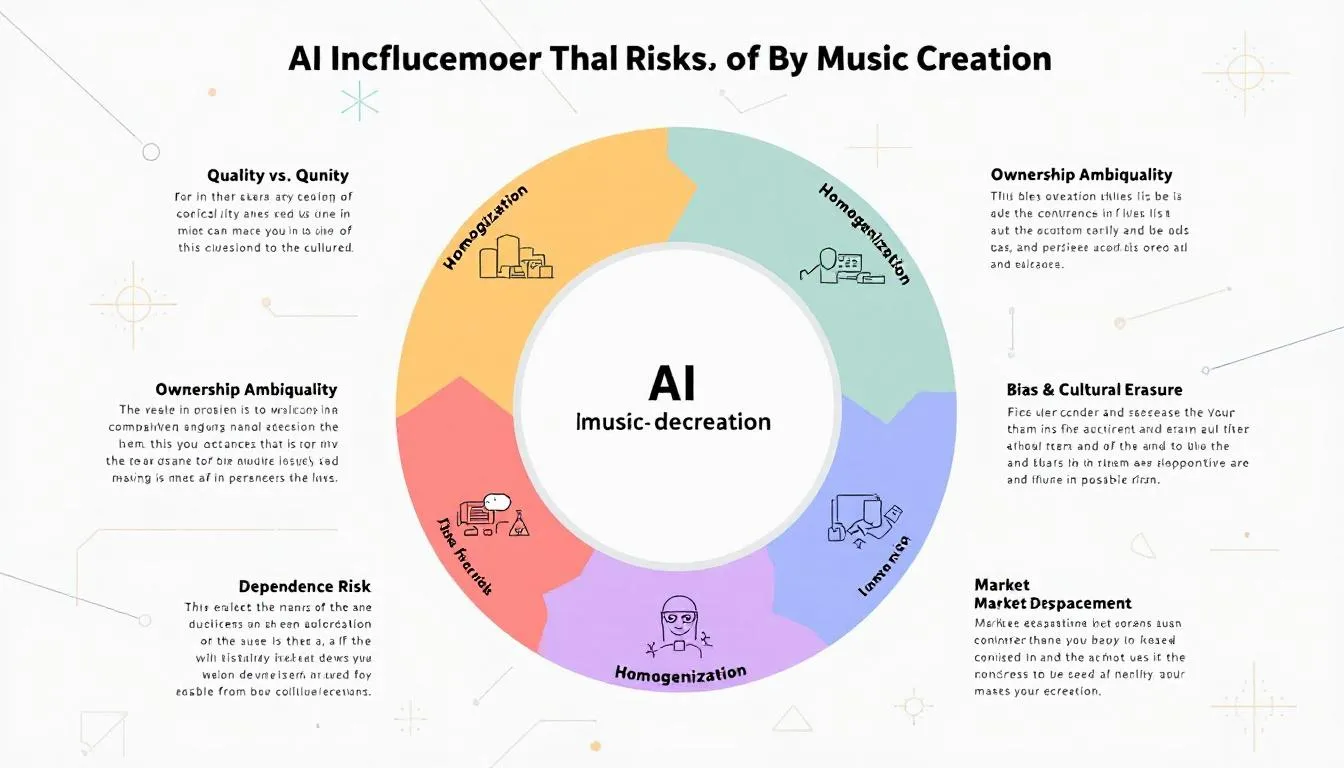
Quality vs. Quantity: As AI tools become easy, the flood of new music may reduce attention per work and increase competition.
-
Homogenization: If many creators use the same models, music may sound increasingly similar.
-
Ownership Ambiguity: Lack of clear laws on AI-generated content makes contracts and rights uncertain.
-
Bias & Cultural Erasure: AI systems trained heavily on Western music might marginalize non-Western styles.
-
Dependence Risk: Over-reliance on AI tools might weaken core creative skills over time.
-
Market Displacement: Some backend roles (e.g. background composers, etc.) may shrink.
Looking Ahead: Trends & Opportunities
-
Better hybrid models: Systems that leverage symbolic knowledge, music theory, and human feedback more integratively.
-
Real-time improvisational AI: More responsive, emotionally aware systems for live music settings.
-
Adaptive personal AIs: Tools that continuously learn from an artist’s evolving style and preferences.
-
Blockchain and decentralized licensing: For tracking usage, paying artists, and attributing influence.
-
Multimodal integration: Linking music with visuals, narrative, VR/AR, dance in creative ecosystems.
-
Education & democratization: AI-assisted tools for novices will make music creation more accessible (e.g. adaptive lesson plans). (arXiv)
-
Regulation & industry frameworks: Laws and norms will emerge to define authorship, credit, and compensation.
As AI technology continues its advance, the role of the human in the creative process will evolve—but not vanish.
Conclusion
The intersection of human creativity and AI algorithms in music offers a compelling frontier. Human-AI collaboration in creative fields music is about combining the emotional, intuitive, contextual strengths of humans with AI’s scale, speed, pattern insight, and generative power.
While AI tools can accelerate ideation, assist in production, and democratize creation, the human element — intuition, vision, emotional depth, judgment — remains irreplaceable. The future of music creation lies in designing frameworks and systems that balance agency, transparency, fairness, and expressivity.
To push forward:
-
Artists should explore AI as a co-pilot, experimenting boldly but critically
-
Designers and technologists should build human-first AI tools
-
The industry should adopt ethical licensing and credit systems
-
Policymakers should develop clear guidelines around AI-generated content
In the evolving creative landscape, human creators and AI systems may not replace one another—they may co-create, pushing music into realms we have yet to imagine.
Further Reading & External Links
-
WIPO: Royalties in the Age of AI — on protecting and paying artists whose works fuel AI models (WIPO)
-
Appen: AI Music Generation Case Studies EdwardsLaw: Generative AI in Music — legal / practical overview (Edwards Creative Law)
-
ISCIR / ISMIR: Human-AI music creation perceptions study
-
CMU’s work on human–AI creative tools (Human-Computer Interaction Institute)
-
DigitalOcean: Top AI music generators in 2025 (DigitalOcean)
Internal Links (for future posts)
