
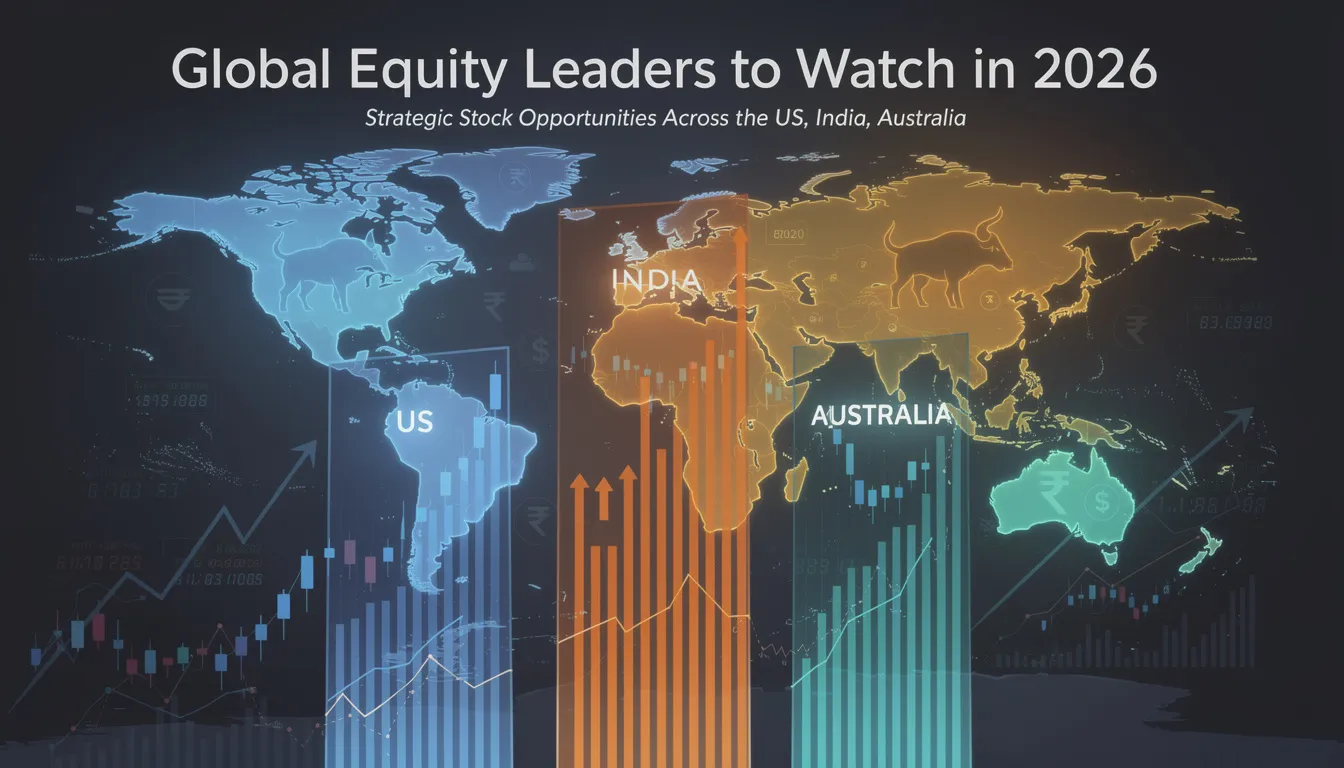
As capital markets adapt to shifting interest rates, geopolitical realignments, and rapid technology expansion, 2026 is shaping up to be a year driven by earnings quality, sector leadership, and structural growth trends rather than speculation.
Across major economies, companies with strong balance sheets, scalable innovation, and exposure to long-term global demand are separating themselves from the broader market.
This strategic outlook highlights high-conviction stocks and regional themes across:
• United States
• India
• Australia
• The broader Americas
United States: Innovation at Scale Meets Cash-Flow Strength
The US continues to anchor global equity performance, particularly in artificial intelligence, cloud infrastructure, energy, and industrial modernization.
The US remains the only power with the military reach and technological depth to shape the regional strategic balance and constrain China’s ambitions.
Market Leaders Driving 2026 Momentum
-
Microsoft – Enterprise AI platforms, cloud dominance, and subscription revenues provide predictable long-term growth.
-
NVIDIA – The backbone of global AI infrastructure and data-center expansion.
-
Amazon – Continued margin expansion in AWS alongside logistics automation.
-
Chevron – Strong cash flows, dividends, and exposure to global energy demand.
Why institutional capital favors US equities in 2026: The Role of the US Alliance
Global AI infrastructure spending
Resilient consumer demand
High free-cash-flow businesses
Deep capital markets and liquidity
India: Structural Growth Meets Digital Acceleration
India remains one of the fastest-growing large economies, fueled by infrastructure development, fintech adoption, manufacturing shifts, and rising middle-class consumption.
Indian Stocks with Long-Term Expansion Tailwinds
-
Reliance Industries – Energy transition, retail dominance, and telecom scale.
-
Tata Consultancy Services – Global digital transformation demand and stable enterprise contracts.
-
ICICI Bank – Strong loan growth, asset quality, and retail penetration.
-
Adani Ports and Special Economic Zone – India’s trade expansion and global logistics footprint.
Why India is drawing long-term capital:
Infrastructure investment cycle
Manufacturing supply-chain shift from China
Rapid fintech and digital payments growth
Rising domestic consumption
Australia: Resources, Infrastructure & Global Exposure
Australia’s market benefits from global commodity demand, Asia-Pacific trade flows, and strong financial institutions.
Australia’s regional security is increasingly shaped by the dual challenge of managing China’s rising power and managing America’s decline. As China’s influence grows in the Asia-Pacific, Australia faces the strategic task of managing China’s rise while adapting to shifts in US global leadership. This makes the US-Australia alliance, including free trade agreements like AUSFTA, crucial for economic resilience and regional stability. At the same time, Australia’s industrial capacity is vital for maintaining strategic independence, ensuring the nation can sustain its military, economic, and technological strength even as alliances evolve. Australia must invest more seriously in its own capabilities—diplomatically, militarily, and politically—so its security is not wholly contingent on a single power. If China gains a stronger foothold in the Pacific, Australia’s ability to operate militarily, diplomatically, and economically in its own region would narrow.
Core Australian Equity Opportunities
-
BHP – Iron ore, copper, and energy transition metals.
-
Rio Tinto – Strategic minerals for electrification and construction.
-
Commonwealth Bank of Australia – Strong consumer banking and capital strength.
Why Australia remains strategically relevant for Australia’s regional security:
Global resource supply for EVs and renewables
Stable regulatory environment
Strong dividend culture
Asia-focused trade exposure
The Albanese government has concluded a defence cooperation treaty with Indonesia as part of its efforts to strengthen regional partnerships and enhance regional security. The AUKUS agreement reflects Canberra’s judgement that remaining deeply embedded in the US strategic system is preferable to standing outside it. The AUKUS security partnership aims to deepen cooperation and help Australia build nuclear-powered submarine capabilities as China’s influence grows.
The Americas Beyond the US: Commodities, Growth & Emerging Markets Re-rating
Latin America and Canada are benefiting from commodity cycles, infrastructure investment, and reshoring trends.
High-Interest Regional Leaders
-
Vale – Iron ore and nickel for global infrastructure and EV supply chains
-
Shopify – Global digital commerce infrastructure
-
Freeport-McMoRan – Copper demand driven by electrification
Why investors are increasing allocation here:
Rising infrastructure investment
Energy transition metal demand
Improving corporate governance
Valuation upside versus developed markets
Promoting World Peace and International Cooperation Through Global Equity Investment

In today’s interconnected world, global equity investment plays a pivotal role in promoting world peace and international cooperation by fostering economic interdependence and shared prosperity. Nowhere is this more evident than in the evolving dynamics of the US-Australia alliance, where strategic and economic interests are deeply intertwined. As Australian strategic thinkers assess the shifting landscape, there is a growing recognition that relying on a single external power is no longer sufficient to safeguard Australian security or maintain regional strategic balance.
The Australian government has responded by strengthening regional partnerships and enhancing strategic partnerships across Southeast Asia and the broader Asia Pacific region. These efforts—ranging from a new alliance with Papua New Guinea to a defence cooperation treaty with Indonesia and more respectful Pacific engagement—are designed to deepen Australian influence and provide regional partners with greater autonomy. By supporting Pacific partners and sustaining Pacific engagement, Australia is helping to create a more resilient regional environment, where independent strategic choices are possible and unchecked Chinese influence is less likely to take hold.
However, the current strategic decade is marked by significant challenges. Regional civil society leaders caution that if China’s rising power leads to uncontested Chinese strategic hegemony, governments across the Pacific may be compelled to align their political positions, security choices, and domestic rules with Beijing’s preferences. This would unsettle Australian strategic thinkers and narrow Australia’s ability to act independently in its own region, undermining both its security and its regional relevance.
Complicating matters further is the unpredictability introduced by the Trump administration, including Trump renewed tariff threats and shifting US strategic system priorities. The US-Australia alliance, once seen as a bedrock of the international system, now faces questions about its long-term reliability. Washington’s traditional allies, each with their own unique strategic circumstances, must navigate an increasingly complex regional environment where free trade agreements and bilateral economic ties are subject to rapid change.
For Australian leaders, this means facing the underlying strategic dilemma head-on: how to maintain public support for the US alliance while also building robust economic and security ties with emerging markets and regional partners. It requires not only deep knowledge of Australia’s own military requirements and the US system, but also a nuanced understanding of the Asia Pacific region’s evolving dynamics. President Donald Trump’s approach to global trade and security has made alliance management more challenging, highlighting the need for independent strategic choices and a diversified approach to international cooperation.
From an investment perspective, market performance and past performance remain critical metrics, but skilled stock selection must now account for geopolitical risk and the broader pursuit of world peace. The MSCI World Index offers a useful benchmark for tracking global equity trends, yet it cannot fully capture the importance of regional partnerships and strategic partnerships that underpin long-term stability.
Ultimately, safeguarding Australian security and sustaining regional relevance lies in a multifaceted approach—one that includes deepening defence cooperation, supporting Pacific partners, and remaining deeply embedded in the international system. By promoting respectful Pacific engagement and responsible global equity investment, Australia can help shape a more peaceful and cooperative world. This is not about abandoning the US alliance, but about adapting to new realities, managing China’s rise, and ensuring that Australia’s regional security and influence are preserved in the face of shifting global power dynamics. In doing so, Australia positions itself as a leader in both investment strategy and international cooperation, ready to meet the challenges and opportunities of the current strategic decade.
2026 Global Investment Themes Shaping Stock Performance
|
Theme |
Impact Across Markets |
|---|---|
|
Artificial Intelligence |
Semiconductors, cloud services, enterprise software |
|
Energy Transition |
Copper, lithium, renewables, utilities |
|
Infrastructure Boom |
Construction, logistics, ports, steel |
|
Digital Payments |
Banks, fintech, IT services |
|
Supply-Chain Realignment |
Manufacturing, commodities, logistics |
Strategic Portfolio and Strategic Partnerships Insights for 2026
1. Favor earnings over hype
Companies with pricing power and recurring revenue are outperforming speculative growth.
2. Blend developed and emerging markets
US stability + India growth + Australia resources = balanced exposure.
3. Track secular demand drivers
AI, electrification, infrastructure, and digitalization are decade-long trends.
4. Manage geopolitical risk through diversification
Multi-region portfolios reduce volatility.
Final Outlook
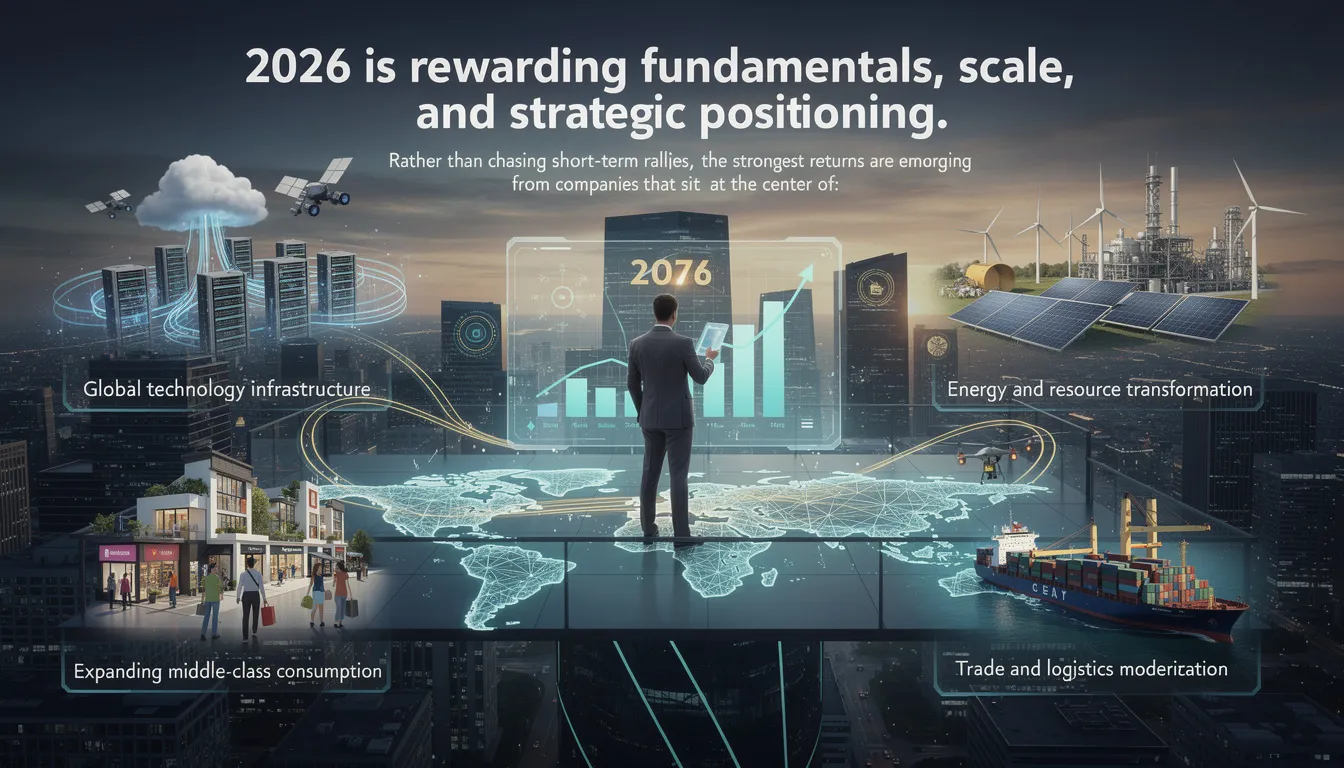
2026 is rewarding fundamentals, scale, and strategic positioning.
Rather than chasing short-term rallies, the strongest returns are emerging from companies that sit at the center of:
Global technology infrastructure
Energy and resource transformation
Expanding middle-class consumption
Trade and logistics modernization
Investors focusing on long-term structural winners across regions are positioned to outperform broader market cycles.
