

Understanding the Space Environment
The Impact of Orbital Debris
Orbital debris, often referred to as space junk, is one of the most pressing challenges in ensuring space sustainability. With the increasing number of objects launched into Low Earth Orbit (LEO), the risk of collisions between active satellites and defunct spacecraft grows dramatically.
Key Facts About Orbital Debris:
-
More than 36,500 objects larger than 10 cm are currently orbiting Earth, with hundreds of thousands of smaller debris pieces posing threats to space operations.
-
The Kessler Syndrome hypothesizes that as debris accumulates, cascading collisions could make certain orbits unusable.
-
Defunct satellites and rocket bodies account for a significant percentage of space debris.
-
Space junk can travel at speeds of up to 28,000 km/h, making even small fragments capable of causing catastrophic damage.
Mitigation Strategies:
-
Active debris removal (ADR) initiatives using robotic arms and harpoons.
-
Space situational awareness (SSA) to track and predict orbital movements.
-
End-of-life protocols, such as controlled deorbiting or moving satellites to graveyard orbits.
-
International cooperation for standardizing debris mitigation policies, such as those outlined by the United Nations Office for Outer Space Affairs (UNOOSA).
For more insights on the impact of space debris, visit Secure World Foundation.
Planetary Protection and the COSPAR Policy
The Committee on Space Research (COSPAR) policy provides guidelines for planetary protection to prevent contamination of celestial bodies during space exploration missions. Adhering to these policies is crucial for preserving the integrity of both Earth and extraterrestrial environments.
Key Guidelines of the COSPAR Policy:
-
Category I & II: Missions to celestial bodies with no significant interest for prebiotic chemistry.
-
Category III & IV: Missions to Mars and other planets with the potential for past or present microbial life, requiring stringent cleaning protocols.
-
Category V: Missions returning samples from celestial bodies to Earth, requiring high levels of contamination control.
Space agencies, including NASA, ESA, and Roscosmos, must comply with COSPAR’s planetary protection measures to maintain the long-term sustainability of space activities.
Sustainable Space Exploration
Responsible End-of-Life Protocols for Spacecraft
To minimize orbital debris, space agencies and satellite operators must design spacecraft with responsible end-of-life (EOL) protocols. These include:
-
Controlled re-entry for satellites in Low Earth Orbits (LEO) to ensure they burn up in the atmosphere.
-
Graveyard orbits for geostationary satellites, positioning them in a region where they won’t interfere with active operations.
-
De-orbiting tethers and drag sails to speed up the natural decay of satellite orbits.
A great example is ESA’s ClearSpace-1 mission, a first-of-its-kind effort to remove defunct satellites from orbit using robotic arms.
Mitigating Space Debris from Mega Constellations
The rise of mega constellations, such as Starlink and OneWeb, has raised concerns about increasing risk of orbital congestion. With tens of thousands of satellites planned for deployment in the coming decade, sustainable deployment and debris mitigation strategies are critical.
Strategies for Sustainable Mega Constellations:
-
Automated collision avoidance systems using AI-powered trajectory prediction.
-
Designing satellites with shorter orbital lifespans, ensuring they deorbit safely.
-
Data sharing among satellite operators to enhance coordination and avoid collisions.
-
Voluntarily taking part in space sustainability rating systems to ensure compliance with best practices.
For updated global space sustainability efforts, visit EPFL Space Center.
Innovative Space Technologies
Reducing Rocket Fuel Emissions
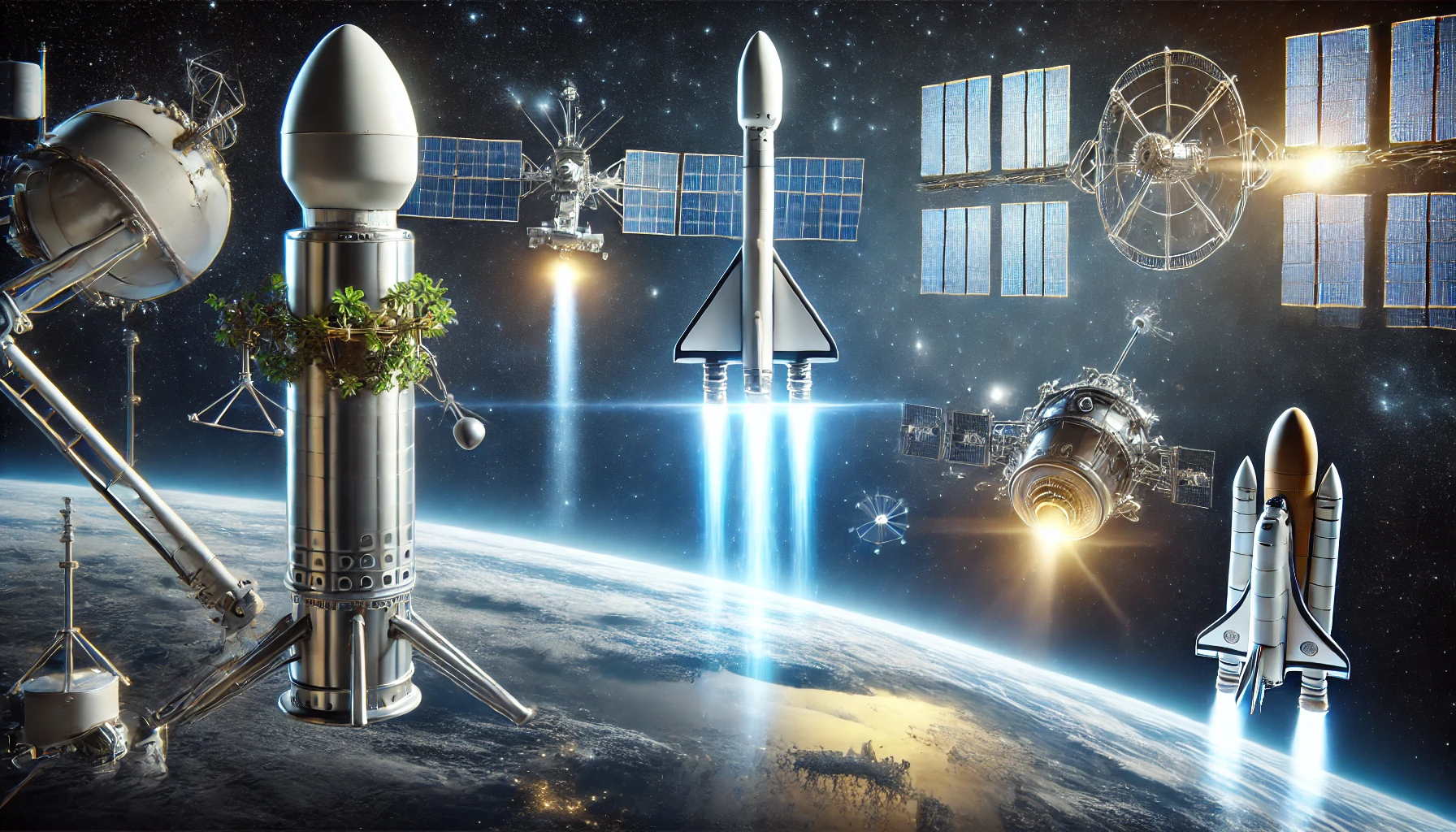
Rocket launches contribute to greenhouse gas emissions and release black carbon particles, which can damage Earth’s atmosphere. Sustainable advancements in launch vehicle technologies include:
-
Green propellants such as non-toxic hydrogen peroxide-based fuels.
-
Reusable rocket systems, pioneered by SpaceX’s Falcon 9 and Blue Origin’s New Shepard.
-
Electric and ion propulsion systems to minimize fuel consumption.
The development of sustainable launch solutions is crucial for the long-term sustainability of space operations.
In-Orbit Servicing and Debris Removal
In-orbit servicing (IOS) refers to extending the lifespan of satellites by refueling, repairing, or repositioning them. Technologies under development include:
-
Autonomous servicing spacecraft that can refuel and repair satellites in orbit.
-
Laser-based debris removal that vaporizes small debris pieces.
-
Magnetic capture mechanisms to remove defunct satellites.
Companies like Northrop Grumman have successfully demonstrated satellite life extension using their Mission Extension Vehicle (MEV).
International Cooperation and Regulation
The Outer Space Treaty and Its Limitations
The Outer Space Treaty (1967) is the foundation of international space law, emphasizing the peaceful use of outer space. However, it lacks enforcement mechanisms to address modern issues like orbital congestion and resource utilization.
Proposed Updates to Strengthen the Treaty:
-
Inclusion of binding regulations for space debris mitigation.
-
Implementation of a global space traffic management system.
-
Defining property rights for asteroid mining and resource extraction.
More information on global space law is available at the United Nations Office for Outer Space Affairs.
Incentivizing Sustainable Behavior
Space Sustainability Rating Systems
Organizations like the World Economic Forum (WEF) and the Secure World Foundation have developed Space Sustainability Rating (SSR) systems to encourage responsible space operations.
How Space Sustainability Ratings Work:
-
Evaluating mission sustainability levels based on debris mitigation and data sharing.
-
Incentivizing companies to adopt responsible behavior.
-
Increasing transparency in satellite operations and launches.
Transparency and Communication in Space Sustainability
Transparency and data sharing between satellite manufacturers, spacecraft operators, and launch service providers are essential for collision avoidance and sustainable operations.
Key Strategies for Improving Transparency:
-
Global data-sharing networks for orbital tracking.
-
Common standards for satellite maneuvering protocols.
-
Public databases for real-time satellite tracking.
Conclusion: The Future of Space Sustainability

The sustainability of space depends on collective efforts from government agencies, private sector stakeholders, and international organizations. As space activities continue to grow, it is imperative to:
-
Implement stricter debris mitigation strategies.
-
Develop innovative green space technologies.
-
Strengthen international cooperation and policy enforcement.
-
Promote transparent space operations through rating systems and open data-sharing platforms.
By embracing sustainable and responsible operations, we can ensure that outer space remains a safe, accessible, and thriving environment for future generations.
For further reading, visit:

rQTReh qMBlp nLkjbx yYKXVL Rzh